Corporate professionals
Client presentations, quarterly reviews, town halls and cross-team updates where visibility is part of the role and nerves arrive with it.
Hypnotherapy Pvt Ltd · Vibha Jain
The fear of public speaking touches professionals, students, founders, teachers and performers alike. If presentations, meetings or the stage leave you tense long before you begin, you are not weak — you are responding to something your mind has learned to treat as a threat.
Hypnotherapy is one approach that may support suitable individuals in working with that learned response, alongside honest preparation and practice.

What it can feel like
For many people the hardest part is not the talk itself. It is the days of rehearsal in the mind that come first — a quiet commentary that grows louder as the date approaches.
Everyone is going to be looking at me.
Anticipation
What if I forget what I wanted to say?
Memory worry
What if my voice shakes and they hear it?
Physical fear
What if I make a mistake in front of my team?
Social evaluation
They will realise I am not as capable as they thought.
Self-belief
I would rather say nothing than risk saying it badly.
Avoidance

Public speaking anxiety is rarely a single moment. It tends to arrive in layers: a thought about the event, a shift in the body, a decision to avoid, and then a memory that makes the next occasion feel heavier. Each layer is understandable on its own. Together they can build a pattern that feels automatic.
Understanding the pattern is not the same as being told to "just relax". It simply gives you something specific to work with — the thoughts you rehearse, the sensations you brace against, and the meaning you attach to being watched.
A more useful distinction
Nervousness before speaking is common and often useful. What people describe as a fear of public speaking, however, can involve several different things at once. Naming them separately tends to make the situation feel less overwhelming — and more workable.
A rise in alertness before something that matters. The heart beats faster, attention sharpens, energy increases. For many speakers this settles within the first minute or two and can even improve delivery. It is not a problem to be removed — only a signal to be understood.
A stronger, more persistent reaction tied to being evaluated. It may include a racing heart, shallow breathing, a shaking voice, dry mouth or a mind that goes blank. It can begin well before the event and linger afterwards as replaying and self-criticism.
Declining the presentation, staying quiet in the meeting, letting a colleague take the pitch, keeping the camera off. Avoidance brings relief in the short term. Over time it can narrow opportunities and quietly reinforce the belief that speaking is dangerous.
Conclusions carried from earlier experiences — "I am not a natural speaker", "I always blank", "people will see through me". These often sound like facts. They are usually interpretations, formed at a particular moment and rarely revisited since.
A learned association between a setting and a state: the projector screen, the boardroom door, the sound of your own amplified voice. The body may respond to the cue before any conscious thought arrives. Learned responses can, with appropriate support, be worked with.
Nothing on this page is a diagnosis
These descriptions are educational. Similar experiences can arise for very different reasons. If anxiety around speaking is severe, persistent, or significantly disrupting your work, studies, relationships or wellbeing, please consult an appropriately qualified healthcare or mental health professional. Hypnotherapy is not a substitute for medical care, emergency support or qualified mental health treatment where those are needed.
The approach
Hypnotherapy uses a focused, absorbed state of attention as a setting for therapeutic work. It is collaborative, consent-based and ordinary in feel — closer to being deeply engaged in something than to anything dramatic.
Within a public speaking context, that work may involve exploring the patterns you bring to speaking situations, rehearsing a calmer response in the imagination, and building associations that are more useful than the ones currently in place. What is appropriate differs from person to person, and outcomes cannot be guaranteed.
A narrowed, absorbed field of attention in which suggestion and imagery tend to be engaged more readily.
Relaxation is used where it is appropriate and welcome — it is a tool within the work, not the work itself.
Practising the experience of speaking calmly in the imagination, so the real room is not the first attempt.
Revisiting unhelpful conclusions about yourself as a speaker and considering more accurate alternatives.

What hypnotherapy is not
It is not mind control, and it does not involve giving up your judgement or your ability to stop at any point. You remain aware and participating throughout. No approach can promise that a specific outcome will follow, and individual experiences vary considerably.
A pathway, not a formula
Every pathway is individual. The sequence below describes how the work is commonly shaped — it is not a fixed programme, and it is adapted to what each person actually needs.
Which situations are difficult, and which are not? A presentation to strangers and a comment in a weekly team meeting can feel entirely different. Being specific gives the work a clear target instead of a vague sense of dread.
What tends to happen first — a thought, a physical sensation, an image of how it will go wrong? Where did the pattern begin, and what has kept it in place? This is exploration, not interrogation.
How hypnotherapy will be used is explained and agreed before it is used. Pace, language and depth are adjusted to what feels acceptable to you, and you can pause or stop at any point.
Guided imagery and suggestion are used to rehearse a steadier way of entering the room, beginning to speak, handling a stumble, and finishing. Rehearsal in the imagination is intended to support — never to replace — real practice.
Structure your message, know your opening, rehearse aloud, learn the room. Therapeutic work and practical craft support each other; neither is a substitute for the other.
Confidence tends to be cumulative rather than instant. Reviewing what actually happened — rather than what you feared would happen — is part of how a new pattern is built and kept.
Who this may suit
Speaking difficulty does not belong to one kind of person. It appears in boardrooms and classrooms, on camera and at family functions. These are some of the situations people bring.
Client presentations, quarterly reviews, town halls and cross-team updates where visibility is part of the role and nerves arrive with it.
Classroom presentations, vivas, group projects and campus events, where being judged by peers can feel as heavy as the marks themselves.
Investor pitches, demo days and first conversations with clients, where a lot can appear to rest on a few minutes of speaking.
Speaking daily and still finding certain audiences difficult — a hall full of parents, an inspection, a conference session.
Leading a team through change, addressing a large audience, or being the person everyone turns to when the room goes quiet.
Stage sessions, webinars, podcasts and speaking to camera, where the absence of a live audience brings its own difficulty.

The practitioner
A calm, unhurried and respectful way of working with people who find speaking difficult.
Vibha Jain practises hypnotherapy through Hypnotherapy Pvt Ltd, with a particular interest in confidence, communication and the anxiety that can gather around being seen and heard. The work is conversational before it is anything else: what happens, when it happens, and what you would like to be different.
No two people arrive with the same history, so no two pathways look the same. Sessions are shaped around your goals, your comfort and your pace — with clear explanations of what is being proposed and why, and honest expectations about what any approach can and cannot offer.
Two halves of the same work
Confidence in speaking is rarely built by one thing alone. Therapeutic work may help with the response you carry into the room. Preparation shapes what happens once you are in it. Presented as competitors, they both underperform; used together, each makes the other easier.
Practical preparation
These are widely used preparation practices, offered as general education. They are not guaranteed solutions, and how useful each one is will differ from person to person.
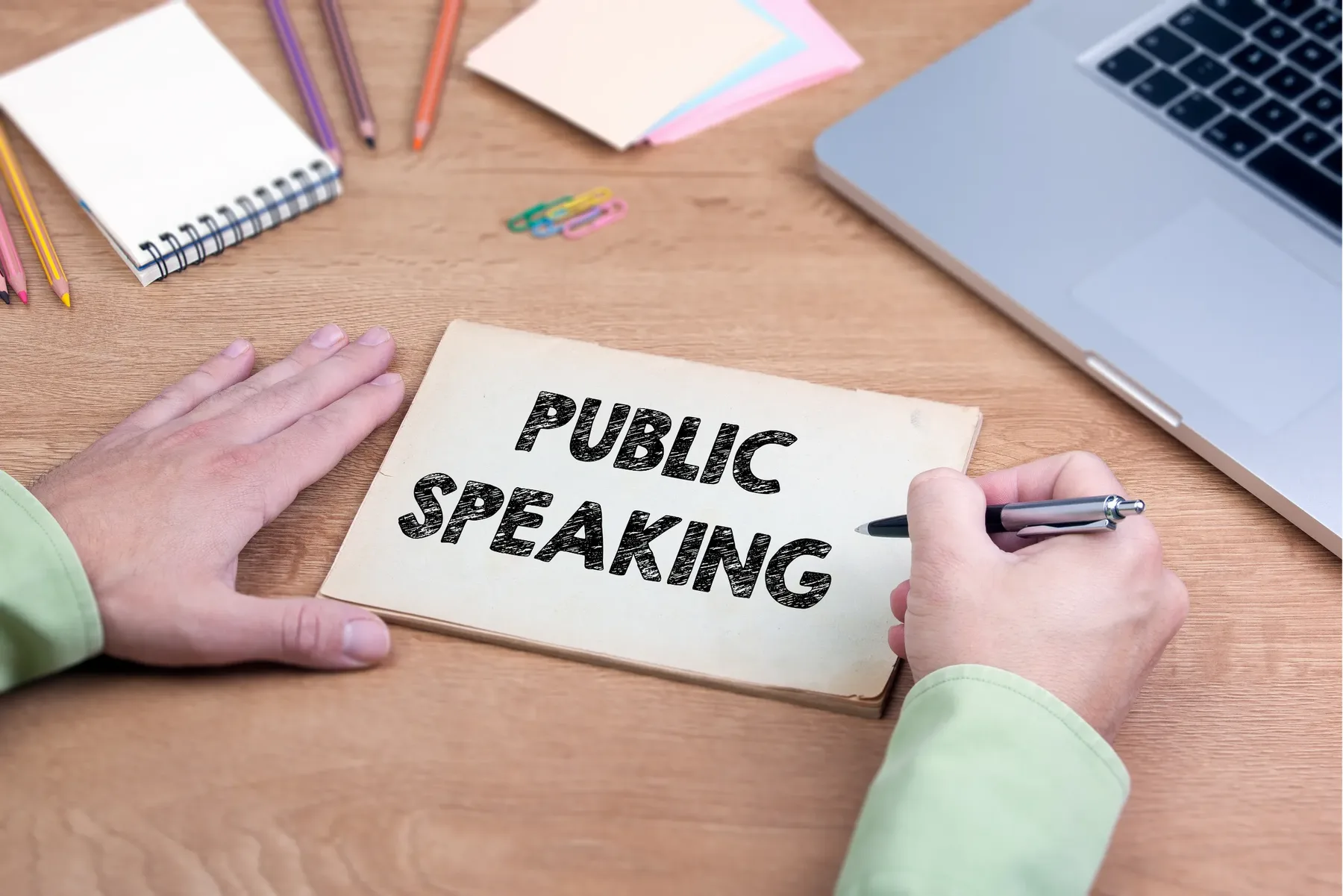
You are not trying to become a different person on stage. You are trying to be recognisably yourself, with less interference.
Common questions
Straight answers, without overstatement. If your question is not here, the full FAQ page covers more — and you are welcome to simply ask.
It is the use of hypnotherapy techniques — focused attention, guided imagery, therapeutic suggestion and discussion — applied specifically to the thoughts, feelings and learned responses that arise around speaking in front of others. The aim is to support a person in developing a more comfortable relationship with speaking situations. It is not a treatment for any medical condition.
Hypnotherapy is best understood as a collaborative process rather than something done to you. People generally remain aware of what is happening and able to stop at any point. The experience varies between individuals — some describe deep relaxation, others simply a state of focused concentration.
No. No responsible practitioner can guarantee a specific outcome. Hypnotherapy may be a helpful supportive approach for suitable individuals, and experiences vary. Any claim of a guaranteed result should be treated with caution.
This is not fixed in advance. It depends on what you are working with, your goals, and how you respond. Rather than promising a set number, it is more honest to review progress together as you go and decide what is useful next.
Many people do, and it is usually encouraged. Therapeutic work and practical rehearsal address different parts of the same challenge. Neither replaces the other.
Your voice deserves space
If speaking has been shrinking to fit around your anxiety, it is worth a conversation. Get in touch to discuss what you are finding difficult and whether hypnotherapy may be an appropriate approach for your goals — with no obligation and no pressure to continue.